2026 Pay Data

Relief Vet Pay Rates
What Relief Veterinarians Actually Earn

Relief vet salary data can be misleading. This guide breaks down real relief veterinarian pay rates by the hour, by the day, by region, and by shift type so you know exactly what to expect and how to maximize your compensation.

Licensed relief veterinarian reviewing pay rates and shift schedule

How Much Do Relief Vets Make in 2026?

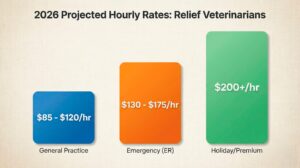
In 2026, relief veterinarians typically earn between $55 and $125 per hour for general practice, with ER and specialty shifts reaching $125 to $165+ per hour. On a daily rate basis, most general practice relief vets earn $600 to $1,000 per day, with high-demand and last-minute shifts pushing to $1,500+.

A relief vet working 4 days per week consistently can expect annual earnings in the range of $120,000 to $160,000, with top earners in high-demand urban markets exceeding that. This is broadly consistent with data published by the U.S. Bureau of Labor Statistics on veterinarian compensation, adjusted for the relief premium and the flexibility structure of locum work.

The American Veterinary Medical Association also tracks veterinarian workforce and compensation trends that inform regional rate differences across the US.

Relief Vet Salary at a Glance

Based on aggregated industry salary data and FlexVet placement data as of 2026.

Typical Hourly Rate

$55 to $125

per hour (general practice)

Average Daily Rate

$600 to $1,500

per shift

Average Annual (Full-Time Relief)

$120K to $160K

industry avg: ~$152K

ER / Specialty Hourly

$125 to $165+

ER, surgery, top markets

Hourly vs. Day Rate: How Relief Vet Pay Works

Relief veterinarian compensation is structured differently from a traditional associate salary. Most relief vets negotiate either an hourly rate or a flat day rate directly with the clinic. Understanding both structures helps you price your time correctly.

Hourly rate structure:

Most common for shorter or variable-length shifts. Typical range is $60 to $150/hr for general practice, with ER and specialty work pushing $125 to $165+/hr. You are paid for actual hours worked, which rewards efficiency.

Day rate structure:

A flat rate for the shift regardless of exact hours. Common range is $600 to $1,500 per day for general practice. Day rates offer income predictability and are preferred by many experienced relief vets for full-day shifts.

Production-based pay:

Some clinics offer a percentage of production (typically 20 to 25% of collected revenue) in addition to or instead of a base rate. This can significantly increase total compensation at high-volume clinics but introduces more income variability.

Quick Comparison

General Practice (hourly) $55 to $90/hr
ER / Urgent Care $100 to $165/hr
Specialty (surgery, derm) $125 to $165+/hr
General Practice (day rate) $600 to $1,000/day
High-demand / Last-minute $1,000 to $1,500+/day

Ranges based on 2026 market data. Actual rates vary by location and experience.

Relief Vet Pay Rates by Region

Geography is one of the biggest drivers of relief vet compensation. Urban markets with vet shortages consistently command the highest rates.

Region / MarketAvg. Hourly RateAvg. Day RateNotes
New York / New Jersey$75 to $165/hr$950 to $1,500/dayAmong highest in the US
Los Angeles / CA$75 to $160/hr$900 to $1,400/dayHigh demand, high cost of living
Northeast (MA, CT, PA)$70 to $130/hr$850 to $1,200/dayStrong urban market
Pacific Northwest$65 to $120/hr$800 to $1,100/dayGrowing shortage areas
Southeast (FL, GA, TX)$55 to $100/hr$650 to $950/dayFast-growing market
Midwest$55 to $90/hr$600 to $850/dayRural shortage areas add premium
Mountain / Southwest$55 to $95/hr$600 to $900/dayVariable by metro vs. rural

Rates are pre-tax estimates based on industry salary data and FlexVet placement data (2026). Actual rates vary by location, experience, and shift type.

What Affects Your Relief Vet Pay Rate

Relief vet compensation is not random. These are the variables that most directly determine where in the range you fall and which ones you can control.

01

Location

Urban markets and veterinarian shortage areas consistently pay more. High cost-of-living cities like NYC and LA top the charts nationally.

02

Experience & Credentials

More years in practice, additional certifications (surgery, dentistry, ultrasound), and a strong relief track record all support higher rates.

03

Shift Type

ER, overnight, weekend, and last-minute shifts command a premium over standard weekday general practice hours.

04

Specialty Skills

Vets with specific procedural skills like dental extractions, soft tissue surgery, or internal medicine can charge meaningfully more per shift.

05

Demand Timing

Booking during peak season or filling last-minute gaps often results in higher rates because clinics are willing to pay more urgently.

06

Negotiation

Relief vets who know their market value and negotiate confidently consistently earn above the median. Most clinics expect negotiation.

Relief Vet Pay vs. Full-Time Associate Salary

Relief work can be more lucrative than a traditional associate role, but it requires strategy. Here's a realistic comparison for a mid-career DVM working roughly 4 days per week.

Full-Time Associate

Base salary ~$100,000 to $120,000/yr
Production bonus $10,000 to $25,000
Health insurance Included
CE allowance Typically included
Paid time off 2 to 3 weeks
Effective hourly ~$45 to $65/hr

Relief Vet (4 days/week)

Day rate range $800 to $1,200/day
Annual estimate $145,000 to $200,000+
Health insurance Self-arranged
CE allowance Out of pocket
Schedule control Full flexibility
Effective hourly ~$100 to $150/hr

Relief vets typically earn more per hour but are responsible for self-employment taxes, health insurance, and retirement savings. Factor in 25 to 30% for taxes and benefits when comparing total compensation.

How to Set Your Relief Vet Rate

Most DVMs undercharge when they start relief work. Use this framework to price your time correctly from day one and make sure you are taking home what you are worth.

Step 1

Calculate your floor rate

Start with what you need to net after taxes and self-employment costs. Factor in health insurance (~$500 to $800/month), retirement contributions (15 to 20% of income), and a 25 to 30% tax rate. Your floor rate is the minimum you can accept and still be financially ahead of a full-time role.

Step 2

Research your local market

Ask other relief vets in your area what they charge. Local market rates matter far more than national averages. FlexVet can give you a realistic sense of what clinics in your area are willing to pay.

Step 3

Add a premium for your strengths

If you have surgical skills, ultrasound experience, or a strong relief track record, charge more. Add $50 to $100/day for specialties, $50 to $150/day for ER or overnight shifts, and a last-minute premium for short-notice bookings.

Step 4

Negotiate with confidence

Clinics expect negotiation. Start at the top of your range and be willing to meet in the middle. If a clinic pushes back hard on rate, that often signals a difficult work environment and is not a great long-term fit.

Step 5

Reassess every 6 to 12 months

As your relief reputation grows, increase your rate. Reliable, experienced relief vets are in short supply and your rate should reflect that over time.

No Fees. No Cut. Ever.

Take Home More With FlexVet

Most relief platforms take a percentage cut of your earnings before you ever see a dollar. FlexVet does not. You set your rate, you negotiate directly with the clinic, and 100% of what you agree on goes to you. No platform fee, no middleman markup, no surprises. That means FlexVet relief vets consistently take home more per shift than vets using platforms that charge a cut.

Relief Vet Pay FAQs

Relief vets typically earn $55 to $125 per hour for general practice. ER, specialty, and high-demand urban markets push rates to $125 to $165+/hr. Nationally, the average hourly rate across all relief vets is around $73 to $144/hr depending on the data source and market.

Annual relief vet salary varies widely based on how many shifts a DVM works. A full-time relief vet working 4 days per week can reasonably earn $120,000 to $160,000 or more per year based on industry salary data and FlexVet placement data as of 2026.

On a per-hour basis, yes. Relief vets typically earn meaningfully more than full-time associates. However, relief vets must self-fund health insurance, retirement, and cover self-employment taxes. When accounting for all costs, strategic relief work can result in higher net income, but it requires planning.

A good starting day rate for general practice relief is $800 to $1,000 per day in most US markets. Experienced vets in high-demand areas or with specialty skills should target $1,000 to $1,500/day. Last-minute or ER shifts often command rates at the top end of this range.

New Jersey, New York, and California consistently rank as the highest-paying states for relief veterinarians, with hourly rates ranging from $75 to $165/hr in top markets. Hawaii also ranks among the top states for overall veterinarian hourly pay.

No. FlexVet does not charge DVMs any fees and does not take a percentage of your earnings. You set your rate and are paid directly by the clinic at 100% of what you negotiate. Because FlexVet takes no cut, relief vets using FlexVet consistently take home more per shift than those on platforms that charge a placement or service fee.

Written by the FlexVet Team

FlexVet specializes in connecting licensed DVMs with veterinary relief work across the United States. Our pay rate data is informed by active placement experience and ongoing veterinary workforce research.

Last updated: March 2026

Related Pages